Designing a More Accessible Conference
A service-design project that used firsthand observation and service blueprinting to consider accessibility across the UX Y'all conference experience.
- Role
- Assessment, Team Collaborator
- Type
- Service Blueprint
- Focus
- Systems Design
From Observation to Opportunity
My graduate program attended UX Y'all to learn from industry professionals and evaluate the conference experience through an accessibility lens. Our challenge was to consider how accessibility could be built into the entire service experience, rather than addressed only at individual level.
We used firsthand observation to document the event, then collaboratively as a team created two service blueprints: one representing the current experience and one proposing a more accessible future experience.
An Interconnected Experience
We observed accessibility across arrival and check-in, opening remarks, session selection, presentations, breaks, closing activities, and networking socials. Rather than focusing on a single touchpoint, we considered how all people, physical spaces, and supporting systems shaped participation in the conference.
Drawing on my experience as a house manager, I contributed a practical perspective to my team on accessibility and safety within event spaces. I focused on how seating, navigation, stage access, and lighting influenced the ways attendees could move through, interact with, and participate in the experience.
Making the Invisible Visible
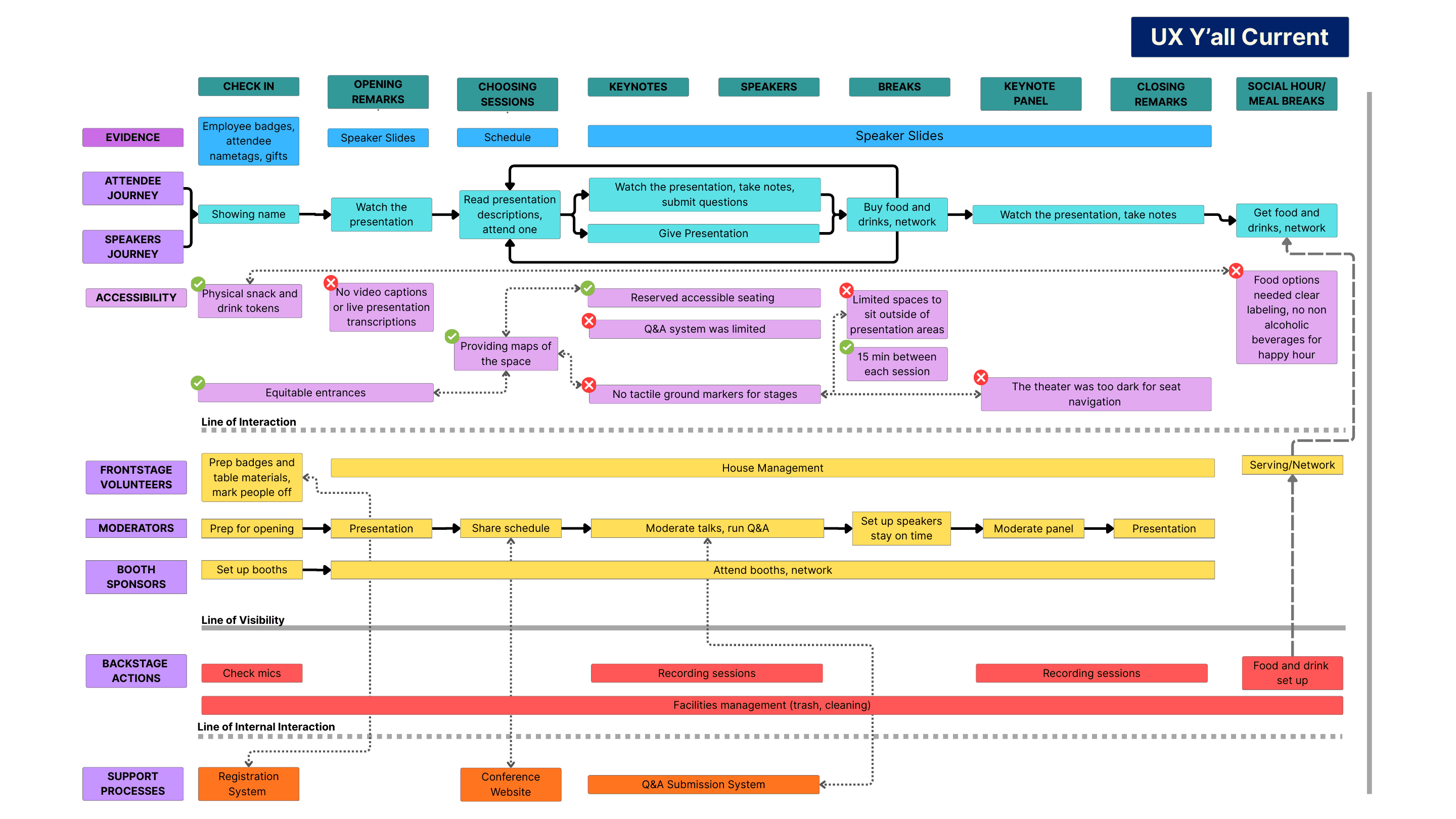
After the conference, we synthesized our observations into a current-state service blueprint, mapping the relationships between attendee experiences, frontstage interactions, backstage operations, and supporting processes.
The blueprint highlighted existing accessibility strengths, including equitable entrances, reserved seating, and intentional breaks between sessions. It also revealed opportunities to improve participation through live captioning, more inclusive Q&A, and clearer navigation throughout the conference.
Reimagining the Experience.
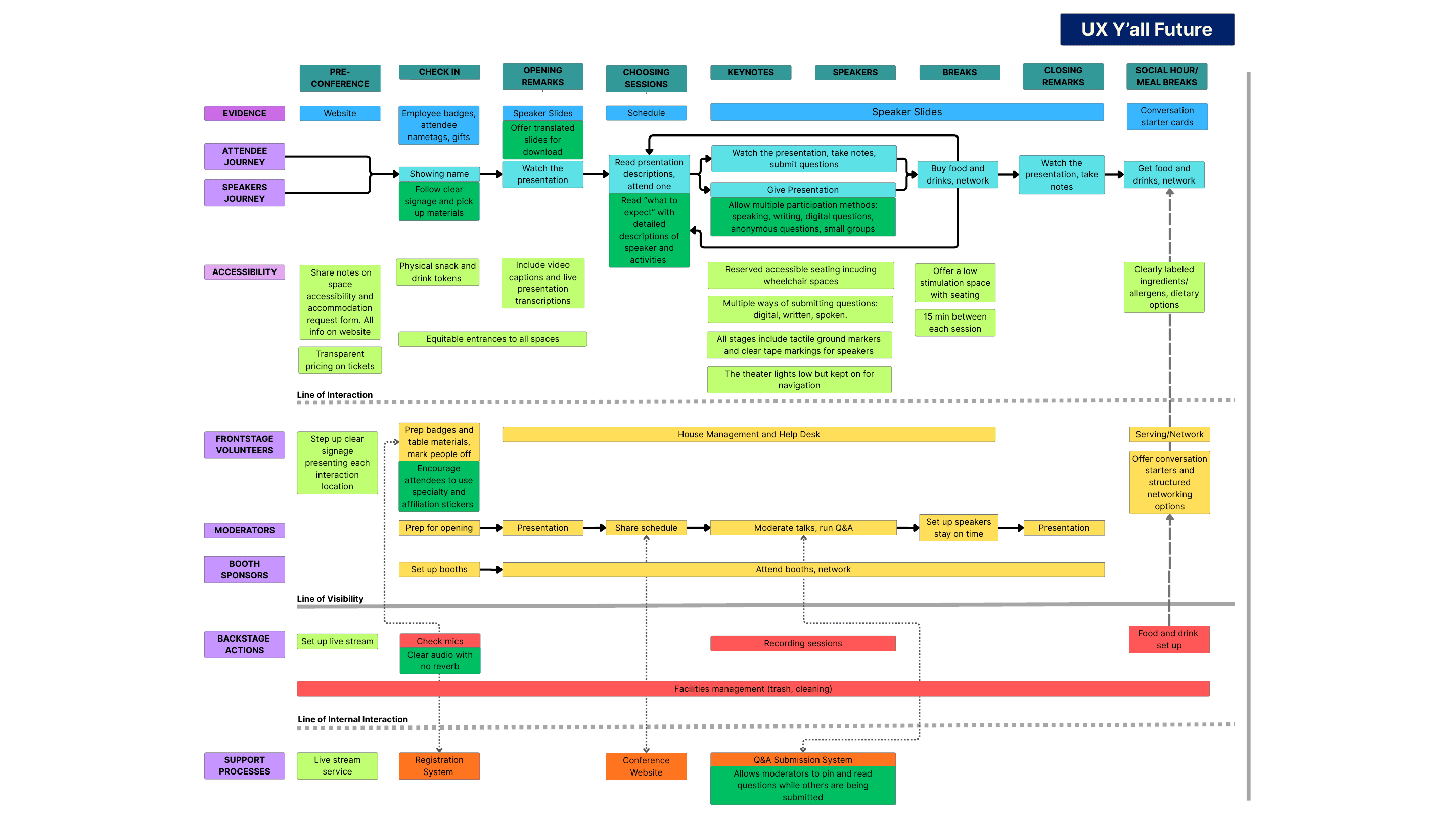
Building on our observations, we developed a future-state service blueprint that explored how accessibility could be integrated throughout the conference experience. Our proposed changes focused on clearer communication, more inclusive participation options, and improvements to physical spaces, including live captioning, flexible Q&A options, and low-stimulation areas.
Rather than addressing accessibility through isolated features, the blueprint considered how these improvements could work together across the event. These proposals provide a direction for future conference exploration and evaluation.